


No other state in the nation boasts as many doves — and hunters hot on their trail — as the Lone Star State, with its longstanding hunting culture passed down through the generations.
So it’s no surprise that a lingering national debate about the use of lead ammunition — whether it should be banned — continues to galvanize scientists, environmentalists, gun rights activists and hunters.
A study released by the Texas Parks and Wildlife Department in December further fueled the debate when it determined steel shot — a lead alternative — is just as effective in its lethality and in hunter satisfaction.
Agency spokesman Steve Lightfoot said reaction to the study has run the gamut.
“Social media comments have run the board, from ‘good to know’ to ‘we still don’t believe you,” Lightfoot told the Current. “This is still going to be an ongoing educational process.”
Lightfoot, however, said TPWD is not getting involved in the contentious debate.
“We are just putting information together that, hopefully, our hunters can make use of to make informed decisions moving forward.”
The Controversy
There is a long-held belief in the Texas hunting community that lead is more effective — and humane — in killing animals.
This is because when lead strikes a target, it fragments into many pieces and slows down inside the animal, breaking bones and piercing organs.
Put simply, hunters believe lead shot kills quicker, preventing animals from escaping and suffering from wounds for a longer period of time.
But the TPWD report, which came with a $500,000 price tag and was funded through Migratory Game Bird and Texas White-winged Dove stamp revenue, sheds definitive doubt on that long-held belief.
To come to this conclusion, TPWD experts recorded more than 5,000 shots fired during the 2008 and 2009 dove hunting seasons in Brown, Coleman and McCulloch counties. Researchers conducted necropsies on 1,100 mourning doves and determined “no statistical significant difference in harvest efficiencies between the three loads tested regardless of distance.” Two kinds of steel shot were compared with lead shot.
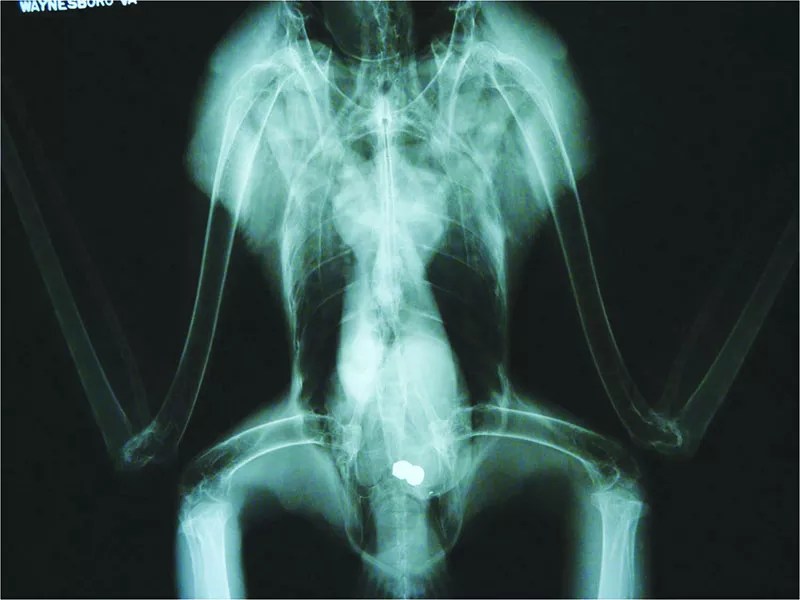
The results weren’t surprising since lead shot has been outlawed in waterfowl hunting for more than 20 years because of its harmful effects. The birds mistake shotgun pellets for grit, or small rocks ingested to aid digestion.
But lead-centric beliefs persist and TPWD found in national dove hunter surveys that hunters find non-toxic steel shot to be inferior.
Take Mark Katzfey, for example. He runs the Katzfey Dove Ranch in George West, about an hour south of San Antonio in Live Oak County. Katzfey, who had not seen the TPWD report, said he couldn’t say for sure that lead was more effective than steel, but he found it hard to believe that steel was just as good.
“You’d have more wounded doves with steel than lead and would hurt your population,” he said. “When we hunt, I don’t want people killing more than the limit. I don’t want to wound.”
By the same token, Katzfey said, lead shot doesn’t leave many wounded doves.
Thousands of lead pellets are strewn across rural fields in Texas counties where doves thrive. They and other upland birds mistake pellets for grit, much like waterfowl do, leading to a painful death from lead poisoning.
While Texas dove hunting is a big deal, the overall debate about lead ammunition is more controversial than many realize.
If lead ammunition were banned in the United States, the hunting and sport-shooting industry would turn on its head, like it did in the early 1990s when lead shot was banned in waterfowl hunting.
“There was no research or science telling us [how to manufacture efficient steel shot],” Lightfoot said. “So, in fact, we were looking kind of blindly down that road and the results were that hunters had some bad experiences initially. Steel shot loads had not evolved.”
Two decades down the line, steel shot has evolved as a non-toxic alternative. Still, the future of lead shot for dove hunting is up in the air.
An Explosive Debate
Seemingly, as with all Texas matters, the steel versus lead debate is mighty big.
And it’s not limited to dove hunting. Lead is used in fishing tackle, like weights and jigs used for inland fishing, and in larger caliber ammunition used to hunt animals like deer.
Jeff Miller, a conservation activist with the Arizona-based Center for Biological Diversity, has managed the “Get the Lead Out” campaign for a decade. The results of the TPWD study were not a surprise to him after the Current brought the research to his attention.
“This is a persistent problem. It’s way past time where we should be addressing this,” Miller said. “We have taken great pains to get it out of all sources, including gasoline, plumbing, pipes, candy and toys.”
The center began its campaign in the wake of endangered California Condors dying from lead poisoning they contracted by eating carcasses or gut piles from animals shot by hunters using lead ammunition.
Hunting with lead bullets and shot is now banned in one-third of California and new legislation seeks to phase it out for the entire state by 2019.
“I keep pointing people toward what is happening in California. The same arguments were made here,” Miller said of the lethality and effectiveness of non-toxic firepower. “It was a big controversy. But none of that came true.”
That’s right on target, according to the TPWD study. Wildlife biologists found hunter satisfaction was exactly the same for steel shot as it was for lead shot.
Litigating Lethality
The center has unsuccessfully tried to up the ante by petitioning the federal Environmental Protection Agency to ban all lead ammunition, subsequently suing the agency after its request failed.
“We’ve unfortunately lost both rounds of litigation,” Miller said. “So on the federal end, we haven’t gotten anywhere. Last year, a bill passed that prevented the EPA from doing anything to address lead in ammunition, but it was only for a year.” Congress is taking up similar legislation this year.
While the Center for Biological Diversity said its petition only focused on lead in hunting, Dave Kopel, former Colorado assistant attorney general and current constitutional law professor at the University of Denver, said the petition was a veiled effort to ban all lead ammunition.
He said the impact of lead on the environment is more nuanced that it appears.
“Hunting is a natural ally in conservation. When there is a general problem shown, hunters will be supportive of restrictions that are carefully tailored to the particular situation, like we have in waterfowl hunting,” Kopel said. “If the Texas conservation agency says steel shot is just as good for dove hunting, I don’t have any reason to doubt them.”
However, for larger game, Kopel echoes Texas hunter Katzfey’s belief that lead is more humane because it kills animals faster and prevents prolonged suffering. Copper is the non-toxic alternative to lead for larger game.
“Everyone supports healthy species and conservation, but it’s important that it be done in a scientifically rigorous way, in a way that doesn’t harm the animals,” Kopel said. “The goal is the humane shot that kills the animal pretty quickly. I think rifle hunting is much better with lead ammo.”
While laws in Texas and on the federal level regarding lead used in hunting and sport shooting aren’t expected to change anytime soon, this controversy will continue sparking a volatile debate in scientific, policy, hunting and environmentalist circles.
“It’s just a hot-button issue, and so being the number one state for dove hunting, we felt we needed to take the lead for our hunters sake, that if there came a time when lead was no longer available for dove hunting, there would be an alternative that would be just as effective,” Lightfoot said.
For Miller, that day is already here.
“There are really good alternatives for every single hunting and fishing activity that uses lead,” Miller said, naming a dozen products from which lead has been removed. “As a society, switching materials for various activities is nothing new.”
This article appears in Little Joe: The Reluctant King.

I am a skeet shooter and have spoken to many British skeet shooters about the lead vs steel issue.
The Brits say that the steel shot is just as effective or even better for skeet targets and they have been using it for years.
The main objections I hear from shooters are cost and damage to the guns we use, especially in the sub gauges of 28 and .410.
I have no information to support or deny wear or damage to a firearm but I don’t think cost can be much of an issue today since lead costs have quadrupled in the last decade. I am confident the firearms industry can solve any wear issues if they exist.
My personal opinion is that lead is not cost effective, especially considering a damage to wild life and there are less costly, better alternatives.
Tom Perry
It’s not a barrel wear issue it’s barrel exploding issue. Older barrels cannot take steel shot.
It’s junk science. Back decades ago there was an outbreak of cholera in duck populations. The antis used pictures from that to justify their agenda of death of 1,000 cuts against guns and hunting. This will never pass in Texas cause a lot of politicians will lose their jobs if it does. Lead sublimates after exposure to air and water and becomes harmless . Iam embarrassed that TP&W wasted our tax money on an agenda driven study.
The idea that lead shot is more lethal because it fragments is false. Lead shot rarely if ever fragments and you wouldn’t want it to if it did. The reason lead shot is more lethal than steel is because of its higher density that allows it to penetrate better. Penetration is what gives a projectile it’s lethality. I further doubt that in areas that doves are hunted that lead shot is ingested by birds for grit. It is too widely dispersed to be available for ingestion and in agricultural area will soon be tilled under. Even in bodies of water, it is a pretty narrow range of scenarios that make lead shot available for ingestion by waterfowl. It is interesting that in CA, where bullets with lead cores are banned, supposedly to protect condors, the alternative is a solid copper bullet. Copper is way more toxic to aquatic life than lead, which is why anti fouling boat paint is copper based. Also a copper roof cap will prevent Moss growing on your roof. I wonder how long it will be until the anti’s pick up on that and try to have copper bullets banned as well.