


Volunteers in fluorescent green vests crawled down steep, rain-slicked embankments in Southeast San Antonio just before sunrise.
Their flashlights were trained on a man at the bottom of the drainage culvert who pushed a torrent of water around with a broom.
The long stretch of ditch parallel to Commercial Avenue between I-37 and Southwest Military Drive cut through a quasi-suburban neighborhood well away from the city center.
The volunteers climbed, crab-walked and slipped down the slick embankment on Wednesday, Jan. 22, to count the homeless camps spread throughout the city. The effort was part of the annual census of San Antonio’s unhoused population, called the Point-in-Time Count.
The 36-year-old man fighting the quixotic battle against the never-ending stream of rainwater was named Efrain, and he was happy to pause his work and answer the volunteers’ questions.
They were conducting the survey to collect data that informs both local and national homelessness statistics, helping the Department of Housing and Urban Development (HUD) identify trends in the transient community.
The morning’s encampment data would eventually be combined with numbers collected during the previous night’s canvassing of unhoused residents on the streets, as well as shelter totals.
Together, the totals create the closest thing to an accurate annual snapshot of homelessness, both locally and nationally.
Other members of Efrain’s encampment — a barefoot woman rocking back and forth in a lawn chair and a crouched man eating a piece of stale bread and smoking a cigarette — were also amenable to answering the group’s questions.
Under the bridge, wooden pallets provided a platform that raised makeshift dwellings — an assemblage of blankets and tarps — out of the water. More than anything, these walled enclosures appeared to create the illusion of privacy in a public space.
Sweeping the problem under the rug
However meager, many of the belongings that make up such camps end up discarded during city-run abatements — or “sweeps” — which take place five to six times daily in San Antonio, according to officials at the city’s Department of Human Services (DHS). The abatements displace camps of homeless residents, often without moving them to an established shelter.
While the abatements were temporarily paused to conduct the Point-in-Time Count and as recent freezes gripped the area, they were expected to resume shortly after.
The city’s 2025 fiscal budget sets aside funding for 1,300 encampment abatements this year, nearly double its goal of 700 the previous year. However, the city’s interactive dashboard shows it far surpassed last year’s objective, carrying out 1,152 abatements.
The sweeps — jointly conducted by the San Antonio Police Department, DHS and Solid Waste Management — displace people like Efrain, whom advocates say are often forced to discard their possessions when they’re moved along. With city shelters overrun and limited permanent solutions like affordable housing available, those caught up in the sweeps often just establish another encampment.
“There’s a degree to which it’s a bottom-up policy,” said volunteer Greg Zlotnick, suggesting the city is responding to public pressure to ramp up the sweeps. “It’s human nature to not want to see what they view in their minds as disorder.”
Zlotnick said displacing people without housing them doesn’t solve the problem. However, there seems to be a public disagreement about what the problem actually is.
“For some, the mere sight of people living outside is the whole problem,” he added.
Before moving on during last Wednesday’s count, the team handed Efrain and members of his encampment necessary items such as hygiene products and gloves.
Would these end up thrown out too?

Life on the edge
On the edge of the culvert, behind a Family Dollar, a man and a woman huddled inside a tent. The man politely answered the volunteers’ questions through the tent flap while the woman coughed profusely inside.
The man told volunteers he has Medicaid but the pain in his hands prevents him from pushing a broom like he once did to earn money.
“What would help you find stability?” Zlotnick asked, posing a question from the survey app on his phone.
“A job,” the man replied simply.
By day, Zlotnick is a law professor specializing in eviction protections, which prevent people from becoming homeless in the first place. He’s also a board member of Close to Home, the continuum of care organization that conducts the PIT Count.
Earlier in January, Close to Home was awarded a $22 million federal grant that includes funds earmarked for initiatives such as housing first programs. Such initiatives eliminate barriers to entry for those who need to find permanent housing.
An emphasis on housing first is one of the reasons Houston is beating San Antonio when comes to addressing homelessness, Zlotnick says, even though the East Texas metro is three times our size.
Recent numbers placed San Antonio at No. 2 in the state for the size of its homeless population behind Dallas. The New York Times and other media outlets have held up Houston as a national model for working to solve homelessness.
Zlotnick was joined in the early morning count by Zebediah Micah Amparan, who works as a case manager for HUD-VASH, Veterans Affairs’ supportive housing program. Marsha Perez — an employee at the Endeavors Supportive Services for Veterans Program, rounded out the crew, even though she had also participated in the previous evening’s street count.
In the misty morning, the team moved on to yet another bridge in the cement ravine, where a fire glowed from inside a tent. A loaded shopping cart was parked next to the structure.
The sides of the tent had been wetted down to prevent it from catching fire, SAPD escort Officer Victor Moreno told the volunteers. Moreno, who’s been on the force for 25 years, much of it patrolling this particular area, knows many of the ditch-dwelling folk by name.

Two women emerged from the tent. One of them, sporting a Nike hat and throat tattoos, said she’d been homeless for six years.
Before ending up homeless, she was a fracking worker in West Texas and had her own vehicle and place. Like the man in the orange tent, all it took was one debilitating medical emergency to put her on the street.
“I had to take medical leave because I fractured my back,” she said.
Harsh conditions
While the two women answered the survey questions, a man in a Punisher T-shirt attempted to push the never-ending stream of rainwater out of the tent. The water flowing into their shared dwelling brought floating trash with it.
The man didn’t have a broom, so he’d stuck a piece of cardboard through the tines of a rake. Working with the makeshift tool ultimately turned out to be another exercise in futility. Water was going to flow through the tent as long as the rain persisted.
Right before January 2024’s PIT Count, rains were so intense that they reportedly swept away five unhoused people who dwelled in drainage tunnels. A separate incident in November of that year also swept away two people camped in the tunnels.
Last year, a record-breaking 364 homeless people died in San Antonio, according to SAMM Ministries — an average of a death per day. Many met their end due to harsh weather conditions.

After fighting his losing battle against the rainwater, the man in the Punisher shirt retreated to a fortress of cardboard, which seemed like a living room for the encampment, and answered the volunteers’ questions.
What did he need right now, they asked. He responded not with what he needed but what the people he looked out for needed, which was winter clothing.
“They’re going to end up dying out here, because it’s the worst time of year,” he said. “They’re going to die.”
Subscribe to SA Current newsletters.
Follow us: Apple News | Google News | NewsBreak | Reddit | Instagram | Facebook | Twitter| Or sign up for our RSS Feed
Related Stories

Volunteers conduct annual Point-in-Time Count of San Antonio’s homeless population
San Antonio’s Close to Home lands $22 million federal grant to combat homelessness

San Antonio’s unhoused population faces limited resources as temps drop below freezing

Ahead of week’s freeze, San Antonio opens temporary overnight shelters for the unhoused

New affordable housing complex debuts on San Antonio’s North Side
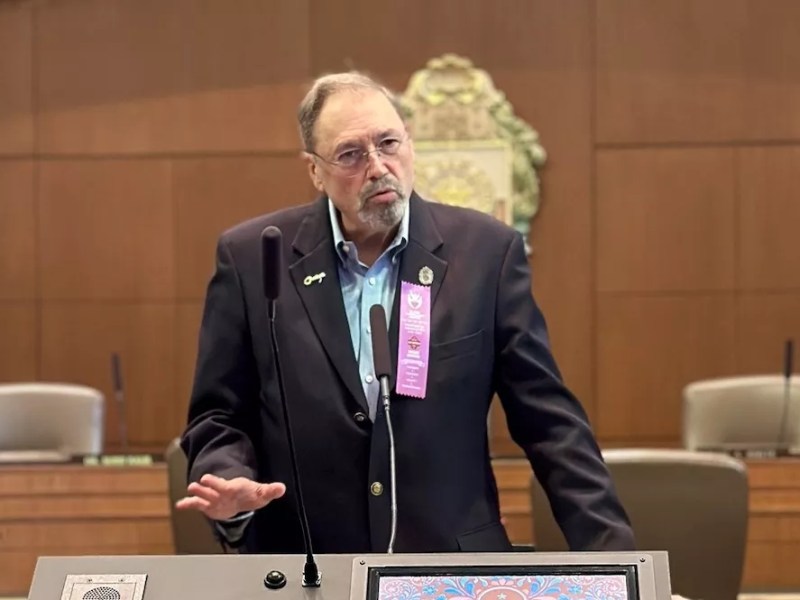
Bad Takes: No, John Courage, homelessness isn’t ‘very easy’

Texas Senate bill would crack down further on homeless encampments
This article appears in Jan 22 – Feb 4, 2025.