

Jones, the former Under Secretary of the Air Force during the Biden Administration, has positioned herself as a San Antonio leader willing to push back against Gov. Greg Abbott and the Trump administration.
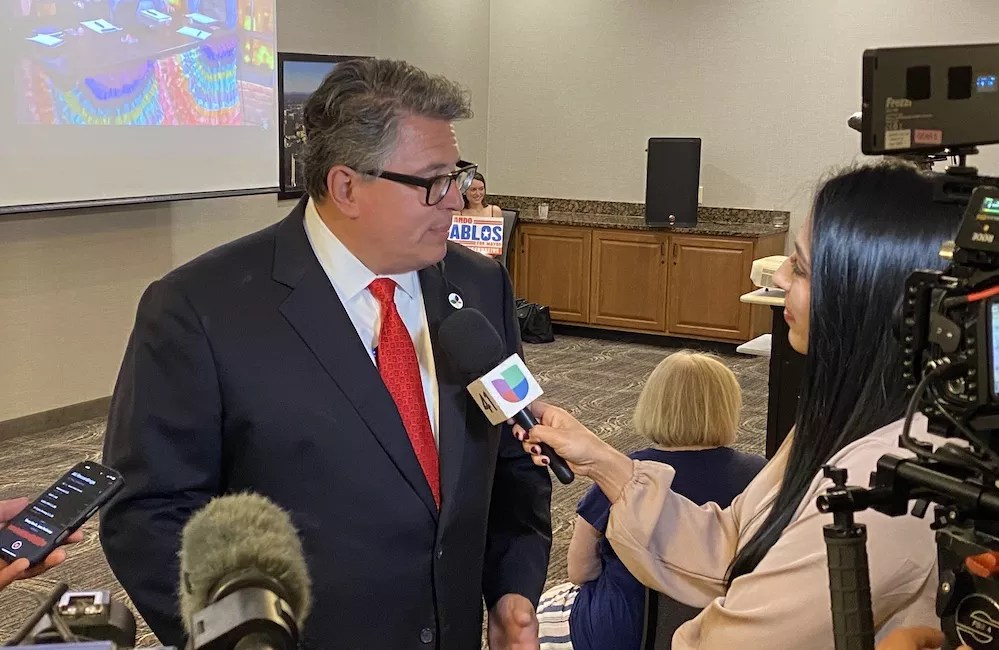
Meanwhile, Pablos — a former Texas Secretary of State appointed by Republican Gov. Greg Abbott — is trying to sell himself as a champion of economic development, which he says will help lift local residents out of poverty.
Talk to Pablos and he’ll explain that his brand of economic development focuses on combating crime, investing in infrastructure and creating a more business-friendly environment. He also maintains Project Marvel, a pricey and controversial plan to create a downtown and entertainment district, will play a big role in the city’s transformation.
“The trick to economic development is to increase productivity in the community, because if all we’re making is tortilla chips, then we’re not as effective as if we were making microchips,” Pablos told the Current this week.
When pointing to his chances of success Pablos points to his background in economic development.
For one, he served as Texas Secretary of State from 2017 to 2018, helping attract substantial Texas investments from enterprises including medical supplier McKesson, construction equipment manufacturer Caterpillar and business-tech firm NTT Data International.
Before that, Pablos served as founding CEO of the Borderplex Alliance, a binational economic development initiative that takes credit for attracting 25,000 jobs and $1.7 billion in investment to the area that includes El Paso, Las Cruces, New Mexico and Ciudad Juarez, Mexico.
“We did some reverse engineering,” Pablos said of his Borderplex Alliance work. “We back into these opportunities by first knowing ourselves and knowing what we could deliver. We knew we couldn’t go out and get Tesla because [El Paso] didn’t have the engineers, but we could get other opportunities, and it worked.”
If elected mayor, Pablos said he plans to use those same tactics to finally help the Alamo City reach its full potential. San Antonio has long trailed Austin, Dallas and Houston in median incomes and economic opportunities, according to economists.
Despite Pablos’ impressive resume, experts question whether a mayor can effectively retool the city’s entire economic-development approach.
Indeed, there are at least a dozen nonprofits and organizations whose goal is to spark economic development in San Antonio, with the city boasting a 6.3% job growth rate between 2018-2023, according to the Greater:SATX Regional Economic Partnership.
However, eliminating poverty is about more than just job creation, St. Mary’s University political scientist Art Vega said.
“We have always tried and strived to be a great city … but if we don’t make some major investments in education, poverty reduction and infrastructure and create a business environment, then we’re going to find ourselves in the same place four, 10 and 20 years from now,” Vega said.
As past mayors have learned, shedding San Antonio’s longstanding problem with generational poverty isn’t easy.
If elected, Pablos wouldn’t be stepping into a CEO role but into the role of a weak mayor in a city government where the city manager holds most of the power. That limits what a mayor can and can’t do, especially in a four-year term, Vega said.
“Mayors really have little leverage on how the economy is occurring nationally, statewide and even on the local level,” Vega said. “Whoever does the work and gets elected also won’t see the fruition of their efforts in a four-year time frame if they really do this.”
Beyond that, San Antonio’s next mayor will face a $150 million budget deficit, which will limit opportunities to spend money on potentially transformational economic development projects, cautions University of Texas at San Antonio political science professor Jon Taylor.
“Can a mayor be involved in identifying generational poverty challenges? Of course, they can,” Taylor said. “But, can they actually … turn that into some sort of jobs program? Not necessarily. The city is strapped for funds, and we’re facing all sorts of federal cuts. How do you go about doing that?”
Still, Pablos argues he has something Jones doesn’t — friends in high places — and that he’d use them to improve San Antonio’s relationship with state and federal leaders. He maintains that he can get meetings with Texas’ top elected officials, not to mention Washington lawmakers and key members of the Trump administration.
“I would also fly down to Mexico City to meet with the President of Mexico and start working with her to develop opportunities of international trade,” added Pablos, a former board member of the nonprofit U.S.-Mexico Foundation.

An economic miracle?
The biggest obstacle San Antonio faces in economic development is that it hasn’t honed in on a specific industry to focus on, foster and grow, Pablos told the Current.
Austin is a tech boomtown, Houston is the world’s energy capital, and Dallas has transformed itself into a nucleus of the financial services industry, even earning the nickname “Y’all Street.” Meanwhile, San Antonio has what? Fiesta?
Based on its current workforce capabilities, location and infrastructure, the Alamo City is best suited to become a hub for manufacturing and financial services back-office work, Pablos said. It’s a similar mix of industries to the one he courted for El Paso.
“El Paso was typically a call center city,” Pablos said. “So we said, ‘What can we bring into this community that is two or three notches above just a call center? So we created a financial services back-office strategy, and we brought in Prudential, Charles Schwab, ADP and others to move to El Paso to perform their back office duties.”
Mario Hernandez, who served as president of the San Antonio Economic Development Foundation for 26 years, agrees those kinds of operations are what the city should target.
“We are at a position now where we can handle very sophisticated office and servicer operations, and that should be our target,” said Hernandez, who helped attract Toyota’s massive truck plant to San Antonio.
Attracting big manufacturing investment may be a trickier prospect, according to Hernandez. He said both the next mayor and city staff must have deep knowledge of international trade and deep contacts within companies looking to relocate.
“When I uncovered the lead on Toyota that Price Waterhouse out of Chicago was heading up the site selection, we went directly to them because we’d been very aggressive in our outreach,” Hernandez said. “What ended up happening is we got on the [site selection] list when they weren’t even looking at San Antonio or Texas. External public relations is very important in economic development, and that’s keeping the name out there and sending the right message.”
Whatever the case, San Antonio-area economic development officials are already focused on chasing both of the industries Pablos said he’d pursue. On its website, Greater SATX identifies “advanced manufacturing and logistics” and “finance and professional services” among its target industries, which also include “cybersecurity and IT” along with others.
Perhaps more daunting for Pablos, San Antonio’s ability to win corporate investment hasn’t alleviated the city’s problems with economic inequality, because economic development is more than just about job creation, according to UTSA’s Taylor.
“Poverty reduction is a long-term project that requires a vision for the city, something I would argue neither Pablos or Jones are talking about,” the professor said. “They need to be talking about how they’re going to encourage job growth, poverty reduction and reduce income inequality, and encourage accessibility to public services that will actually provide a social safety net, things like access to daycare and free public transportation.”
No incentives, except…
Frequently, cities use economic incentives to recruit business relocations and investment. For example, San Antonio last year approved a $24.4 million incentive package for Toyota’s expansion of its local plant that included a 10-year partial tax break and millions in infrastructure along with certain fee waivers and a $1 million grant.
If elected, Pablos won’t have much wiggle room to offer incentives as the city grapples with its $150 million budget deficit.
The candidate said he isn’t concerned.
“I’m not giving out incentives,” Pablos said. “The incentive should be doing business in this community. We want to find companies that would appreciate moving here or starting an operation here that aren’t asking for incentives.”
That tune may change when it comes to the Spurs, however.
Pablos and Hernandez both told the Current that the city’s best brand ambassador is the San Antonio Spurs. The Spurs organization has increased the city’s international standing by being one of the NBA franchises to draft stars from abroad, including Argentina, France and Australia.
To that end, Pablos told the Current he’s open to using revenue from the hotel and visitor tax — but not the city’s general fund — to help pay for a new Spurs arena and Project Marvel, including a billion-dollar Alamodome renovation.
“The Alamodome has been producing a bunch of economic impact,” Pablos said. “People belittle it, but just the Final Four brought in $400 million into the community. This is job creation and economic development.”
However, UTSA’s Taylor warned that Pablos’ willingness to spend public money of any kind on the murky Project Marvel is likely to prove controversial.
Even if the Marvel money and city operating expenses come from different funds, the perception of possibly needing to cut specific programs to balance the budget deficit while simultaneously building a new arena could spell political disaster for whoever becomes the city’s next mayor.
“That’s going to be a hard sell,” Taylor said. “I mean, ‘We’re going to build a new basketball arena for the Spurs, but sorry, kids, for cutting your summer swimming program.’ That’s what it’s going to come down to.”
Early voting for the runoff runs May 27-June 3. Polls will reopen from 7 a.m.-7 p.m. on June 7.
Subscribe to SA Current newsletters.Follow us: Apple News | Google News | NewsBreak | Reddit | Instagram | Facebook | Twitter | Or sign up for our RSS Feed
Related Stories

LGBTQIA+ group blasts Ron Nirenberg for not endorsing Gina Ortiz Jones in San Antonio mayoral race

San Antonio mayoral candidate Rolando Pablos says he’ll appoint ‘homelessness czar’

Gina Ortiz Jones gets endorsements from ex-San Antonio mayors, nearly half of city council

Early-voting turnout in San Antonio mayoral runoff suggesting trouble for Gina Ortiz Jones, expert says

San Antonio mayoral hopeful Gina Ortiz Jones refuses to answer Express-News question about her middle name

Bad Takes: Gina Ortiz Jones is a better choice for San Antonio, but she can’t go it alone

Gina Ortiz Jones wins San Antonio mayoral race despite being outspent by conservative rival
This article appears in May 14-27, 2025.