

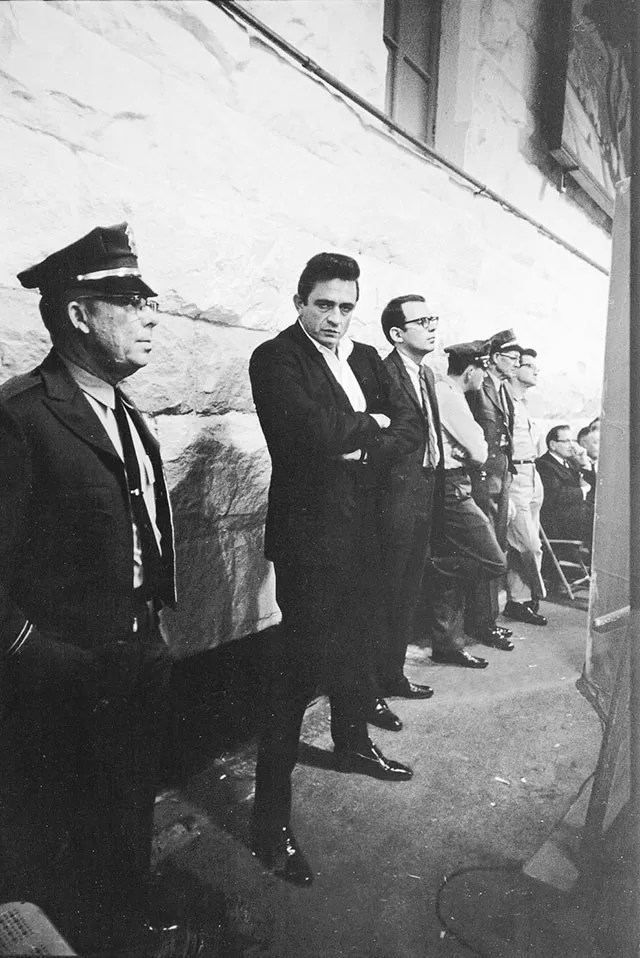
As the Los Angeles Times‘ pop music critic for more than three decades (1970-2005), Robert Hilburn was the type of editor that would edit with the writer sitting right next to him, going line by line, and celebrating an improved sentence with effusive high fives. He applied that same passion to his Johnny Cash: The Life, arguably the ultimate biography of The Man in Black.
As a freelancer in Los Angeles for almost five years in the early ’90s, I had the good fortune of working directly under the supervision of "Bob," as we all called him. And he was every bit as Bono would describe him years later in the introduction of Hilburn’s memoir Corn Flakes with John Lennon and Other Tales from a Rock ‘n’ Roll Life—Hilburn wasn’t interested in "scenes," but in sounds, and was able to see something in young, flawed bands that gave him fuel, while the bands themselves got inspired by the wisdom of the ever-youthful veteran writer.
"Bob’s role as critic was to encourage suspension of disbelief in the audience, but in the artist as well," wrote Bono. "That is an environment in which music grows. He made us better. … Without ever being pious or elitist, he has the Levitical/Jesuitical energy of a keeper of the flame."
Hilburn, who recently turned 74, spoke to the Current on the phone from his home in Sherman Oaks, an LA suburb.
Why another book on Johnny Cash?
I don’t want to sound pretentious, but I wanted to treat Cash like a president, almost. What I found missing from a lot of biographies of celebrities, music or actors, is that they talk about the person’s life but they don’t really talk about the artistry of the person, why the person is important in any way. They’ll say whether the film is a hit or not, but they don’t say why he or she wanted to make the film. Was it good or bad? I wanted to say why he was important, so that 50 years from now, and I think Cash will be remembered 50 years from now, a person will read the book and will get the sense of why he was important during these times. One of the things I liked the most about your book is how, early on, you tell the story of rock ’n’ roll from Cash’s perspective, as a link between country and rock ’n’ roll. That was one of my favorite moments. I loved Sun Records. This [book] combined all my interests in music: I loved country music, I loved blues, I loved rock ’n’ roll, and I was a fan of Johnny Cash as a teenager. The difference is that I loved Elvis, and Chuck Berry, and Little Richard, and Buddy Holly and all of those guys, but they were speaking to me as a teenager, teddy bears, and hound dogs… Cash was only a couple of years older than Elvis, but when I heard “Folsom Prison Blues” he had an adult voice and adult themes, so it really struck me. “I shot a man in Reno just to watch him die…” I was shocked when I heard that. I didn’t know you could say that on the radio!
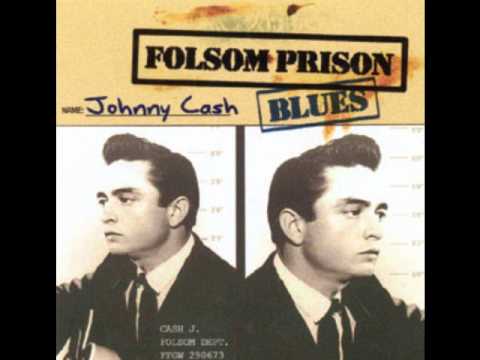
I was used to people saying, “One, Two, Three O’clock, Four O’clock rock!” “I want to be your teddy bear” or “Whole Lotta Shakin’ Goin’ On.” There was a lot of sexual terms but not a lot of adult darkness stuff. There was something serious about Cash. I heard a lot of country music, but he wasn’t like other country stars. That’s one of the main things I tried to answer with the book: why was he different? Why did he have a sense of artistry? Coming from a cotton patch in Arkansas and entering a country field where no one else before him, no matter how big the star, had no more ambition than another hit in the jukebox, why was Johnny Cash different? In all my years as a journalist with the Los Angeles Times I pretty much knew everything. I interviewed Lennon, and Dylan, Springsteen, Bono, Stevie Wonder, Michael Jackson… And I thought I could get a pretty good read on people. I thought that, if you talked to somebody, you had the final answer, that they were the final authority. But when I started writing the book I realized how little we know about celebrities and how much I didn’t know about Johnny Cash, even though I was around him over and over and over again in his life, doing stories about him. Celebrities choose to tell us what they want us to hear. I don’t really know what Bob Dylan is really like, even though I’ve interviewed him a dozen times. But when writing this book, I would find out that things [Cash] said were just not true, and I don’t think he was trying to lie, but make the story a little bit more interesting, so he would embellish upon it. And the people around him, everyone sees something different. And there would be little things, like the first time he flew into Memphis, after being in the Air Force; [someone] says he came to Memphis on the Greyhound bus, [San Antonio’s] Vivian [Liberto, Cash’s first wife] says he flew into the airport, Cash said he flew but Vivian wasn’t at the airport. So you have to talk to so many different people to figure out what likely happened. So at one point you have to be sort of like a judge to the whole thing. Those are the simple things, but the hard part is when there are significant things and you’re trying to piece together what the truth is. I wasn’t within 50 miles of what Johnny Cash’s life was really like. His personal life turned out much darker than I thought it was. He had burdens, and guilt, and drugs, things that weren’t quite honorable, and I was really surprised. But at the end of the book he comes off as a hero, because he keeps fighting through all that stuff to make music that inspires somebody. I kept telling myself, “Oh my gosh… should I tell people about this? Is this too private or not?” Some members of the family didn’t want you to say things that might hurt their dad’s image, but [daughter] Rosanne Cash was very good about this. She said, “I don’t care how uncomfortable it makes me feel; if it’s the truth, tell the truth.” That was very helpful. It was a difficult journey but I just loved every minute of it. (continues on the next page)
This article appears in Oct 23-29, 2013.