

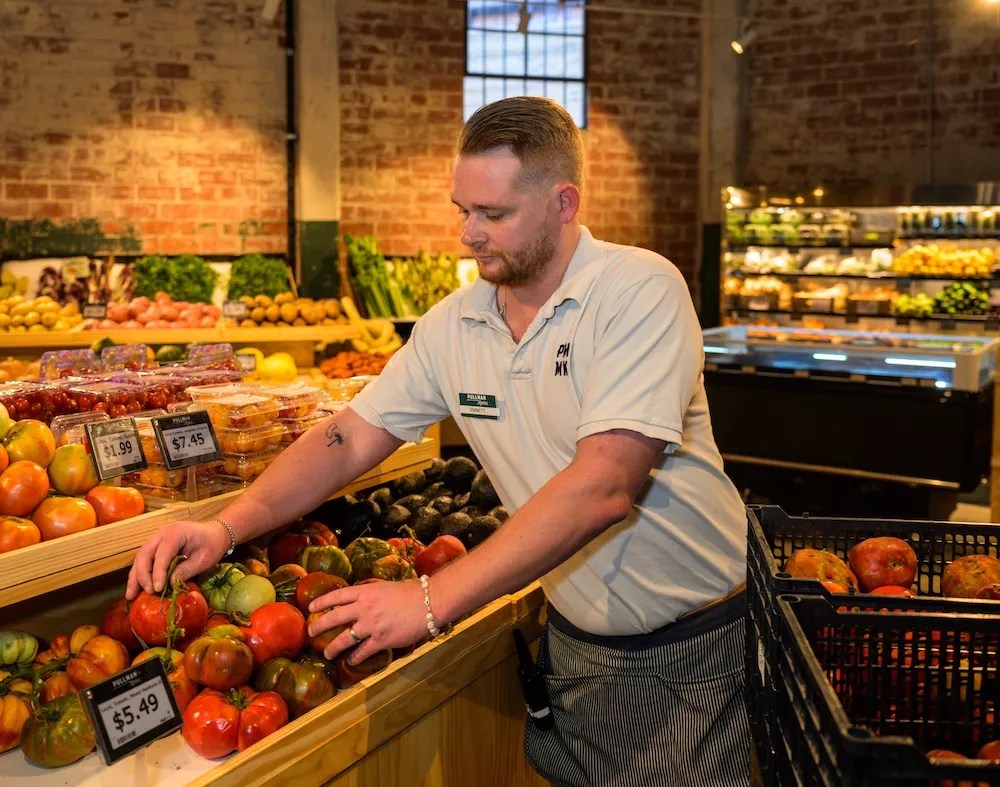
Touted as the largest culinary market in the Southwest, San Antonio’s new 40,000-square-foot Pullman Market is indeed a beast to behold.
The foodie mecca opened at San Antonio’s Pearl complex in late April, boasting shelves upon shelves of top-quality groceries and colorful displays of locally grown produce. Casual to-go food stands operate inside Pullman, along two full-service restaurants: Fife & Farro and Mezquite. Two more restaurant concepts are also in the works.
Though visually arresting, the opening left some locals wondering exactly who Pullman is here to serve. San Antonio is one of the nation’s poorest big cities, after all, and the venture opened inside a high-end development many perceive as catering more to tourists than locals.
To be sure, a smattering of comments on Alamo City social media have questioned whether Pullman truly serves the needs of the community. Some of that early animosity may even be spurred by the fact that the market’s owners hail from further up I-35.
Austin-based Emmer & Rye Hospitality Group, which developed Pullman Market, is responsible for other upscale eateries, including Ladino, also at Pearl. Nearly every one of the group’s concepts has gained national accolades thanks to a team helmed by chefs Kevin Fink, Tavel Bristol-Joseph and Berty Richter.
Aesthetically, Emmer & Rye eateries exude elegance, and each offers up its own particular blend of impeccable service and next-level eats. So why the interest in the Alamo City, which is nearly synonymous with Tex-Mex and more casual dining experiences? And why at Pearl, a development with which some San Antonians have grown disenchanted?
“We had an open dialogue about that feeling with [capital firm] Silver Ventures and Pearl right from the start, and that really steered so many of our decisions,” Emmer & Rye CEO Fink told the Current. “I would love to tell you that there was a whole focused business meeting about it, but the reality is that we know we’re the new kids. We still need to fight for respect in the community. And we still need to make sure that people understand what we’re doing.”

Low-income city
Sounds like a solid sentiment, but do the Emmer & Rye team truly know where they are?
After Philadelphia and Houston, San Antonio is the third-poorest among the nation’s 10 most populous cities, according to the U.S. Census Bureau’s most recent American Community Survey. The survey, based on 2022 data, also shows that 18.7% of the Alamo City’s 1.4 million residents lived below the poverty line. Further, the average household income is just $58,829 annually.
Yet Pullman is located steps away from Pearl’s Can Plant apartment building, which offers compact 505-square-foot studios that start at $1,673. Its largest floor plan — a 1,307-square-foot, two bedroom, two bathroom option — begins at $3,308 per month.
Folks who can pony up that kind of dough for living quarters might not feel the quake of sticker shock when perusing the goods at Pullman Market. The prices on its fresh produce, Texas-made pantry goods and chef-prepared grab-and-go foods are on par with other higher-end specialty grocers such as Whole Foods and Central Market.
According to Fink and Pullman’s general manager of retail, Noah Bradley, those prices aren’t meant to make shopping an exclusive experience but to reflect the quality and care that goes into each curated product the market stocks.
Pullman’s developers are wagering that plenty of San Antonians are willing to spend more if it means supporting sustainable agriculture and local businesses.
“One of the most common first reactions is, ‘We think it’s expensive,’” Bradley said. “We’re never going to be able to undercut H-E-B or Central Market, beat those prices, because we’re something different. But we’re not trying to be everything for everyone. We’re not trying to offer 100 different products in one specific category. We’re trying to offer 10 of the best items in that category.”
He added: “And recently, people are making more conscious decisions when they’re selecting what food they’re eating, and we’re able to come in and really push that idea and speak to that on a different level because we have the relationships with the suppliers that we do.”

Conscious and sustainable
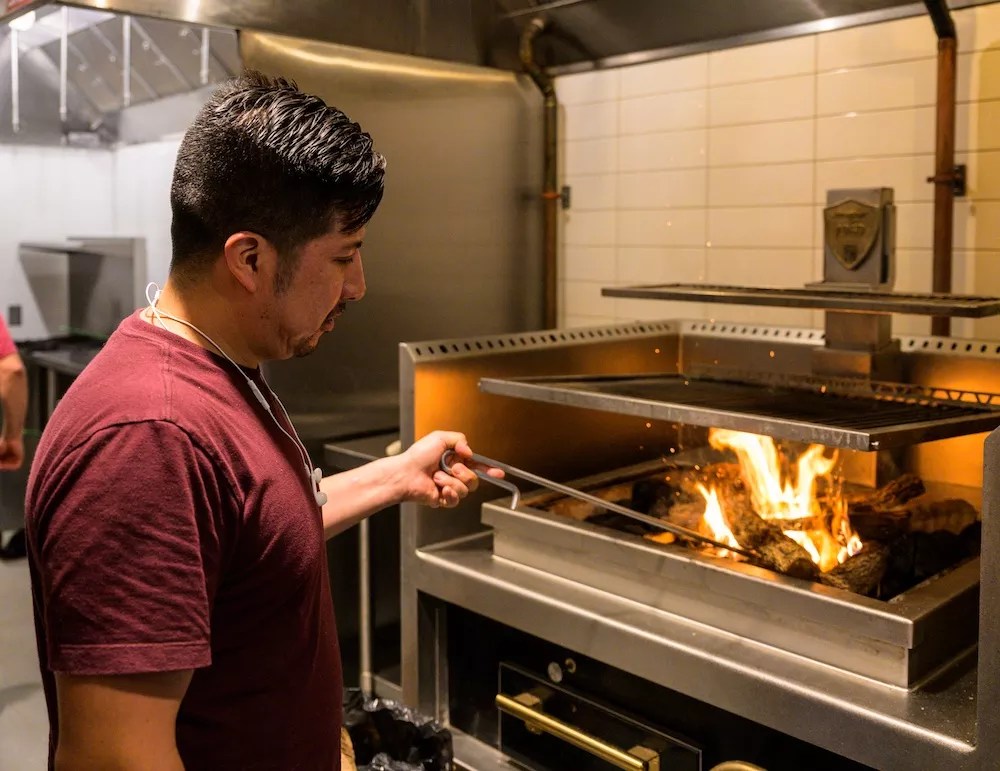
Those suppliers include the ranchers and fishing boats that provide meat and seafood to Pullman’s whole-animal butcher. The onsite butcher shop sources each of the market’s eateries with proteins such as beef for burgers and tacos, and whole Gulf Coast fish for ceviche and aguachiles. Texas ranchers truck their wares to the market weekly, and the team breaks down each animal, ensuring every part is used.
The sustainable practice is known as whole-animal utilization, and Pullman prides itself using it daily.
“These ranchers pull up to the back loading dock, and they’re rough, they’re tired, they’ve been working since dawn, but they’re so proud of what they have to offer. And that pride absolutely rubs off on us,” Pullman Market head butcher Matt Levere said. “And everything gets used, there’s zero waste. The meat goes to the restaurants, the beef tallow gets jarred and put in our grab-and-go case. It’s truly an example of sustainable practice on a huge scale.”
Each rancher that supplies Pullman Market is dedicated to conscious and sustainable practices, meaning their animals are raised in accordance with humane animal welfare standards and environmental best practices. The resulting meat is not only sustainable, but nutritional and exponentially more delicious, according to Pullman officials.
Because Pullman is dedicated to showcasing local and regional suppliers, its chips, snacks, coffee, bottled drinks and more tend to made by small companies who can’t operate at the economies of scale of massive food producers.
Spending local
While that means higher prices, Fink said he hopes shoppers understand the value of spending locally.
“What we’re hoping to highlight is that, for every $1 spent in a community, anywhere from $1.74 to $2.25 goes back into that community. You spend it at a chain restaurant, or a bigger retail grocer, and only around 56 cents goes back,” he said. “We’re doing everything we can to inject the local economy, and we’re doing that by prioritizing quality, freshness and locality in all of the products and at the restaurants. So, guests will generally pay more than they would at a big box retail grocery store, but we feel it’s worth the extra effort for the best quality, Texas-made products.”
It may be surprising to learn, but 99.8% of Texas enterprises are considered small business, according to the Small Business Administration. Pullman Market brought 325 jobs to the historic Pearl complex, and it gives shelf space to more than 200 Texas-based vendors, including area farms including J&D Farms, Green Bexar Farms and Texas Food Ranch.
In the eyes of the team behind Pullman Market, the tangible, direct relationships people can develop with their food is paramount.
“Coming out of COVID, we have all of these new technologies, like Instacart and grocery delivery, that were birthed in that time period where people didn’t have access to farmers’ markets or the grocery store. Checking their fruits and vegetables and really connecting with their foods fell by the wayside,” said Emmer & Rye partner Bristol-Joseph, an award-winning pastry chef.
“Our children could no longer have that relationship that our parents had with food, where they know how to pick a ripe melon, for instance,” Tavel Bristol-Joseph added. “All of the fundamentals of picking the perfect fruit when you go to the store, of touching a mango and feeling how soft it is … our kids are probably never going to experience that if we continue to have this dialogue that food is just transactional.”
Given San Antonio’s deep-seated relationship with food and gathering, maybe the Pullman team knows its audience after all. The question becomes how well it can convey that narrative and convince skeptics that the market isn’t exclusive but accessible.
Subscribe to SA Current newsletters.
Follow us: Apple News | Google News | NewsBreak | Reddit | Instagram | Facebook | Twitter| Or sign up for our RSS Feed
Related Stories

Here’s where to take Dad for Father’s Day meals, discounts in San Antonio

Pullman’s Fife & Farro and Mezquite offer distinct, but equally elevated experiences

San Antonio restaurant Lala’s Gorditas asks diners for help again

Pros at San Antonio’s Pullman Market share their must-try items

Table Talk: Getting to know Pullman Market retail guru Noah Bradley

Both Mezquite and Ladino at San Antonio’s Pearl have added brunch service

Partners behind San Antonio’s Pullman Market reflect on its first anniversary — and what’s next
This article appears in Jun 12-25, 2024.
