

Cityscrapes is a column of opinion and analysis.
As sparse details have trickled out about “Project Marvel,” the city’s grand scheme for a new Spurs arena at Hemisfair, a convention center expansion, a new hotel, Alamodome improvements and a new highway deck, one thing has been conspicuously absent.
No one has stood up and announced what greater purpose the project serves, why it’s necessary for our community and why they support it.
Sure, lame duck Mayor Ron Nirenberg and some downtown folks have made sounds of support, and we’ve heard murmurs of agreement from some city council members and a seeming acquiescence from County Judge Sakai.
A dozen or candidates for the mayor’s job will be on the May ballot, and none seems to be screaming out support for Project Marvel.
To point, no local elected officials or major candidates have emerged as energetic promoters and salespeople for the vision of creating a grand new “sports and entertainment district” downtown.
That relative silence is despite the stellar rhetoric that’s been part of city staff presentations on the proposed district.
“Potential transformative and iconic effects,” “quality of life for residents,” “new visitation” and “enhanced connectivity” are just some of the promises touted as staffers revealed early details of Project Marvel in presentations.
Yet it still remains a mystery as to what exactly will be transformed, what an “iconic effect” actually is or how having a new arena could possibly improve San Antonio’s quality of life.
We’ve heard the promise of “new visitation” before — namely every time the city extends tax breaks to a new hospitality property. And while we now have a whole bunch of new hotels all around downtown, our economy has remained remarkably unchanged and the city center primarily remains a destination for tourists.
As for the “enhanced connectivity” part, lots of our neighborhoods are still waiting for sidewalks or decently paved streets.
The contrast between Project Marvel and San Antonio’s grand public development projects of the past couldn’t be more stark.
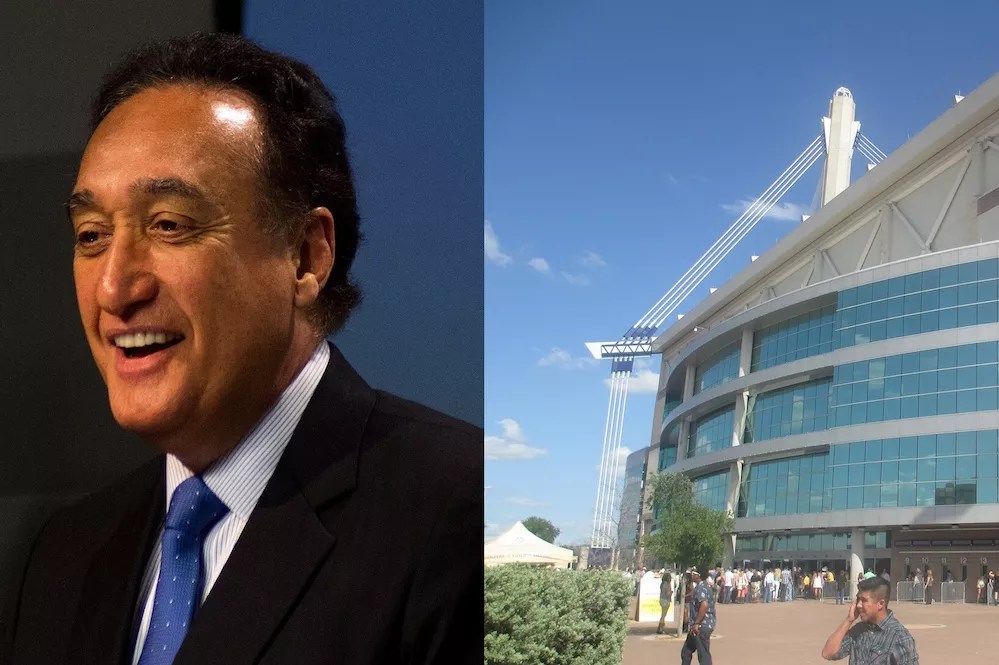
The push and politicking for the Alamodome was clearly a product of then-Mayor Henry Cisneros. He made the quest for an NFL team — a goal long sought by city business leaders — a key goal early in his second term.
Cisneros pressed one financing plan after another — a restaurant tax, a private development scheme — in a bid to win broad support while finding a way to pay for the stadium without raising property taxes or going to a bond vote. He finally landed on the idea of using a portion of VIA’s sales taxing authority, although that would require approval by the Texas Legislature.
The campaign for the dome was all about Henry Cisneros, an effort he dubbed a “holy war” over the vision for and future direction of the city. He touted the dome as a “multipurpose convention and sports facility” that would bring new meetings and conventions to town and boost job creation.
Whether the dome actually delivered on the promises of convention success and job creation is debatable. It certainly failed to win San Antonio an NFL team. But its realization was thoroughly a product of Henry Cisneros.
The saga of the AT&T Center’s birth was much the same.
The Spurs organization made no secret of its unhappiness over playing at one end of the Alamodome. Built for football, the dome’s abundant seating and sightlines simply didn’t suit basketball.
The Spurs searched for both a site for a new venue and a way of paying for it. The team joined the push for state “venue tax” legislation that offered a way to fund an arena with taxes on hotels and car rentals. And with a hug from County Judge Cyndi Krier to then-Spurs honcho Peter Holt, county officials fully backed the arena deal and the “Saddles & Spurs” campaign that sold it to voters.
More recently, Julián Castro proclaimed and pressed for the “Decade of Downtown” during his time as San Antonio mayor. Castro made the case to the community for boosting downtown public investment and for subsidizing new downtown housing that ostensibly would transform our central core.
So, where are our local politicos as the public still remains in the dark about the cost of a new Spurs arena, the future for the Frost Bank Center and the full tab for all of Project Marvel’s wonders? And why are we being denied the opportunity to consider all the possible projects and public investments that the venue tax might support across our entire community?
Nirenberg will become a private citizen in June without the megaphone of the mayor’s office. Now, we need to hear from all the mayoral candidates and those vying for council seats about where they stand on both the new arena and the larger Project Marvel.
If the need for a new arena is so imperative, surely there are public officials and local business leaders who could help explain how Project Marvel will serve this community. Similarly, the Spurs’ owners could speak publicly about what they’re committed to contribute.
If no community leaders have the courage to speak up and endorse this grand vision, that speaks volumes.
Heywood Sanders is a professor emeritus of public administration at the University of Texas at San Antonio.
Subscribe to SA Current newsletters.
Follow us: Apple News | Google News | NewsBreak | Reddit | Instagram | Facebook | Twitter| Or sign up for our RSS Feed
Related Stories

San Antonio residents should push county leaders to ask tough questions about Project Marvel

The big numbers attached to Project Marvel’s convention center expansion don’t add up

Narrow margins for two San Antonio ballot propositions should be warning for city leaders

San Antonio Spurs star Victor Wembanyama out for rest of season with blood clot
This article appears in Feb 5-18, 2025.