For decades, Texas politicians and pundits have preached that marijuana reform advocates are blowing smoke.
But there’s a new normal — literally and figuratively — in the Lone Star State and in the Alamo City.
“Everybody feels the energy,” said Marisa Laufer, a board member of the San Antonio chapter of the National Organization for the Reform of Marijuana Laws (NORML). “It’s great to watch this happen, that San Antonio is a part of it and it’s not a fringe issue anymore.”
Just a couple of weeks ago, SA NORML organized a march downtown to drum up support for marijuana reform. The public show of support for weed, which drew approximately 300 people, was a first for San Antonio.
Times do change.
Just a year ago, SA NORML was an organization that barely had a public presence.
That was because of internal disorganization and a lack of dedicated volunteers. But marijuana reform is a mainstream conversation now and 2015 has been a record session at the Texas legislature, as politicians seriously considered everything from legalization to medical marijuana.
It was enough to fire up Alamo City weed advocates, who are lobbying for change on the local and state levels.
Laufer said the group opened up a bank account and now members pay dues — anywhere from a $20 basic membership to $1,000 for a lifetime deal. As for the size of SA’s chapter, Laufer said the board is still working to identify how many members exist. “We don’t know how that’s been handled in the past, so it’s still a case of cleaning that up,” Laufer said.
Jamie Balagia, a defense attorney popularly known as the “DWI Dude” and for running for attorney general last year (he resoundingly lost) is interim executive director and there’s now a board of directors. The group is also working on outreach, particularly online with a website and by ramping up its social media presence.
“We’re getting help from the Austin NORML Chapter,” said Laufer. “We’ve been getting the support we needed to help get this chapter in a better position.”
‘Cite And Release’
Aside from organizational grunt work, Laufer said SA NORML has also set out new goals, including increasing membership and lobbying Bexar County District Attorney Nicholas “Nico” LaHood to implement a little known Texas law called “cite and release.”
This rule allows police officers to issue citations to people suspected of Class B misdemeanors, such as possessing small amounts of pot, rather than arresting them.
The accused would be expected to answer to allegations at a scheduled court appearance, skipping being booked, arrested and posting bond.
Police previously told the San Antonio Current that they wouldn’t use the law without a directive from the DA’s office.
Just days before beating former DA Susan Reed in last year’s election, LaHood told the Current that he would explore implementing the law in Bexar County.
But Laufer has her doubts. She has been trying to schedule a meeting with LaHood to talk about implementation but hasn’t been able to speak with him. She did however, snag some time with a representative in LaHood’s office who promised the DA was not ignoring her.
“He’s not ready to comment or maybe he’s just buying time and they say they want to get back to us, but we don’t think he has made a decision,” Laufer said.
LaHood’s top deputy, Woody Halstead, told the Current that the DA’s office is still investigating whether the cite-and-release law would effectively improve Bexar County’s judicial system.
“We have talked a little bit with Sheriff (Susan) Parmerleau and Chief (Anthony) Treviño about whether or not we want to move that direction,” Halstead said.
But there are logistical issues, including whether people will show up to court and how to determine the identity of suspects when they show up for court, according to Halstead.
“Most people go through the booking process and are finger-printed so we can ensure the person is the right person,” Halstead said. “With cite and release, we have to work out logistical issues with that because we don’t want to have an issue later on.”
But even then, Halstead said Bexar County’s jail has a low number of people accused of Class B misdemeanors because most people go through booking and are released on a personal recognizance bond after a judge magistrates them, which generally takes a few hours.
“It may not be effective because of the low number of offenders,” Halstead said.
Making History
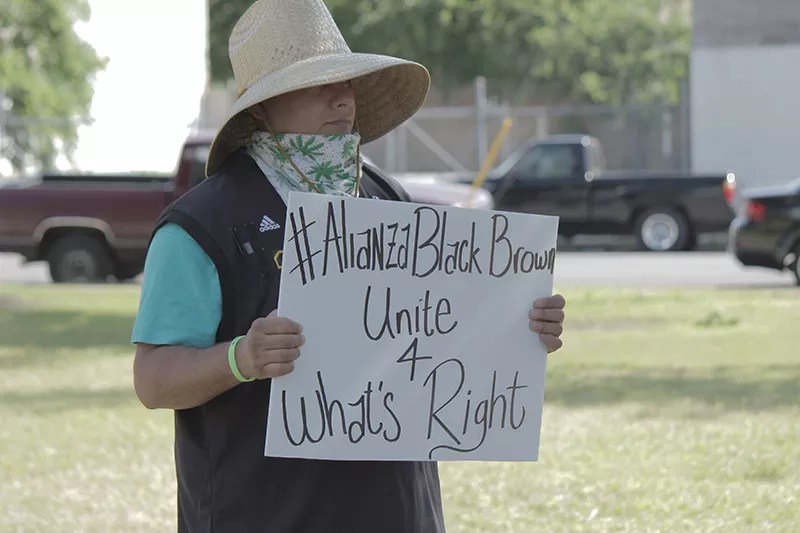
While Laufer and other SA NORML members may face dozens of hurdles trying to implement cite and release in Bexar County, the mood for reform advocates is celebratory.
“Texas is big. It’s quite the state. We need to make it better and there are plenty of people who can turn the history around,” Laufer said. “That’s what I truly believe.”
In fact, the mood is infectious and the reform movement is growing in Texas.
May marks the most unprecedented legislative conversation the Lone Star State has ever had about marijuana. This year, politicians filed 11 bills targeting full legalization, medicinal pot and decriminalization.
One of those proposals would legalize the sale of cannabis oil — it doesn’t cause euphoria — for treating severe intractable epilepsy.
Republican Senator Kevin Eltife came up with the proposal and both the Senate and the House approved the measure. Now it goes to Gov. Abbott’s desk.
Heather Fazio, Texas political director for the Marijuana Policy Project, a national pot-lobbying group based in Washington, D.C., that has set its target on the Lone Star State, said the fact that the state’s leaders have recognized medical marijuana is a huge victory.
However, the bill is not ideal because it is too specific and the way it’s worded would result in doctors breaking federal law, according to Fazio.
While the legislation would allow doctors to prescribe the cannabis oil, there’s no way anyone who wants to hold on to their practice and their assets would do so.
“There’s a difference between prescribe and recommend with regards to doctors and patients. In several federal court cases, judges have ruled that doctors who are issuing prescriptions for marijuana are aiding and abetting a federal crime,” Fazio said.
Yet those same courts have ruled that physicians who recommend medicinal marijuana are exercising free speech and may not be punished for it.
Phillip Martin, deputy director for Progress Texas, a left-leaning advocacy group, said while the bill doesn’t go far enough, it’s historic.
“I think we’re leaving behind a lot of important people. This is a big opportunity to really improve health care for veterans with PTSD and children with epilepsy by not addressing the full-scale medicinal marijuana bill,” he said. “That being said, progress is progress. This conversation transformed the chamber from perceiving marijuana as something to giggle at to something serious.”
Then there was the bill that surprised everyone.
Republican Representative David Simpson wanted to legalize marijuana based on religious reasons. He dubbed it the “Christian case” for legalization, arguing that God didn’t make a mistake when he created marijuana.
While it never got scheduled for a vote, Simpson’s legalization push actually made it out of committee.
“That was totally unexpected,” Fazio said.
Then there was El Paso Democrat Joe Moody, who proposed decriminalizing marijuana. His bill would have removed arrest and the possibility of a criminal record for possession of one ounce or less of marijuana, replacing the offense with a $250 civil fine.
Again, another progressive pot bill actually made it out of a committee and had a chance at being scheduled for a vote in the House of Representatives. The vote never took place, despite broad support. The Marijuana Policy Project crafted the bill and convinced Moody to support it.
However, last week marked the end of marijuana reform in Austin — for now.
Meanwhile, groups like SA NORML, the Marijuana Policy Project, Progress Texas and a host of other advocates plan to reorganize for the next legislative session, in 2017.
According to Martin, that gap between legislative sessions will be crucial in terms of growing the movement.
“We have legislation to organize around and can build on,” Martin said, adding that marijuana reform advocates will organize town halls and meet with law enforcement and health officials. “We’ll talk about opportunities for marijuana policy reform in Texas and build off of that momentum to make 2017 the best.”
If 2017 is anything like this year for marijuana reform, it’s sure to be a doozy.


This article appears in Generational Shift.