


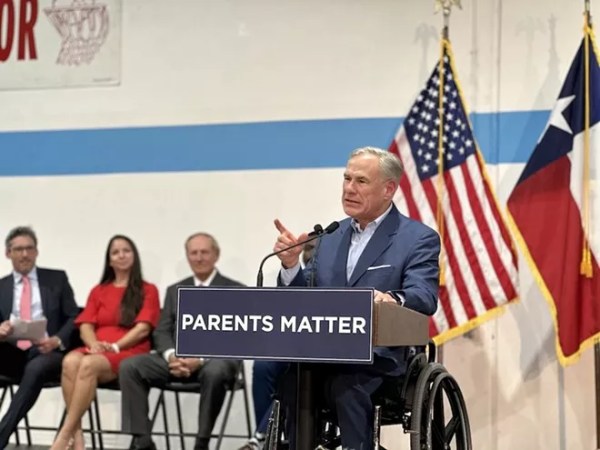
AUSTIN — After 10 hours of tense debate, the Texas House voted overnight to pass Senate Bill 2, a sweeping piece of legislation that creates a controversial $1 billion school voucher program backed by Gov. Greg Abbott.
The vote in the Republican-controlled House was 85-63, largely along party lines. Democrats opposed the legislation, which Abbott made his top legislative priority for the session. The Republican governor has expended enormous amounts of political capital to pass vouchers after a similar measure he backed in the prior legislative session died in the House.
“This is an extraordinary victory for the thousands of parents who have advocated for more choices when it comes to the education of their children,” Abbott said in a statement. “When it reaches my desk, I will swiftly sign this bill into law, creating the largest day-one school choice program in the nation and putting Texas on a pathway to becoming the best state in America for educating our kids.”
The bill, as amended, would create “Education Savings Accounts” parents can apply for to help fund private school tuition for their kids. The program will prioritize low-income families and those whose children have disabilities — but only if applications to join the program exceed its capacity.
Two amendments added during the House debate also make significant changes to the original proposal.
The first of those requires that private schools be in operation for at least two years before they’re eligible to accept vouchers. The second caps funding for students with disabilities and those from high-income households — defined as a family of four making $156,000 or more — to 20% of the program’s total budget for each year of its existence.
Democrats and other voucher critics argue the legislation uses tax dollars to push students out of public schools, potentially creating a funding crisis for the state’s public education system. As evidence, they point to similar funding shortfalls in other states that have adopted vouchers.
During debate, Rep. Harold Dutton Jr., D-Houston, argued that the $10,000-per-child allocation under the proposed voucher scheme amounts to a coupon program for the rich. The money isn’t enough for poor families to fully fund a child’s tuition and expenses, he added.
“If you’re in a 12-foot-hole and somebody sends you a 10-foot-rope, that’s not much of an option,” Dutton said.
Although the House voted to approve SB 2 in Thursday’s wee hours, lawmakers still must cast a final vote Friday before the proposal can head back to the Senate, where it originated. Once there, members from both chambers will hash out their differences during a closed-door conference committee before presenting a final bill to Abbott.
The most tense moment of the night came when Democrats, led by Rep. James Talarico of Austin, in a last ditch effort, proposed an amendment to let voters decide whether they want vouchers via a statewide referendum.
Talarico said the amendment was necessary due to Abbott’s intense pressure campaign on members of his own party. During the prior election cycle, the governor bankrolled primary campaigns against a number of GOP House members who voted against vouchers during the 2023 session.
“No one, including the governor, should ever threaten a lawmaker,” Talarico said. “We do not serve the governor; we serve our constituents.”
Talarico told Texan News reporter Cameron Abrams his amendment initially had bipartisan House support. However, that support evaporated Wednesday after Abbott began calling House members into his office one-by-one and threatening to make their primary elections a “bloodbath,” the Democrat added.
“So, I’m a little confused, because the governor has said school vouchers are widely popular,” Talarico told Abrams. “If he’s telling the truth, I would think this referendum would have no trouble passing.”
Freshman Rep. Mitch Little, R-Lewisville, in a tense standoff on the House floor, accused Talarico of lying about the threats and called the amendment unconstitutional.
“Article 3 of the Texas Constitution provides that no law — none, zero — no law shall be passed except by bill,” Little said during the exchange.
Veteran capitol journalist Scott Braddock of the Quorum Report wrote that Abbott argued in the 48 hours leading up to the debate that putting vouchers to a statewide vote would be unconstitutional. However, when Abbott served as Attorney General, he raised no such objection to a provision that would have put legalizing horse and greyhound racing to a statewide vote.
Meanwhile, a representative from Abbott’s office denied Talarico’s accusations that the governor had threatened House members.
“This is absolutely not true,” Abbott spokesman Andrew Mahaleris told reporters. “Governor Abbott has been speaking with members encouraging them to vote for school choice.”
Subscribe to SA Current newsletters.
Follow us: Apple News | Google News | NewsBreak | Reddit | Instagram | Facebook | Twitter| Or sign up for our RSS Feed
Related Stories

Texas House passes $8 billion public-education spending bill

Trump makes rambling phone call to Texas House GOP Caucus ahead of critical school voucher vote

Texas’ school voucher bill clears hurdle, heads to House floor
Analysis: Gov. Greg Abbott spins damaging lies as he pushes school vouchers

Here’s how Texas House members representing San Antonio voted on school vouchers

Ending 30 years of resistance, Trump and Abbott break ‘The People’s House’

‘It’s what’s best for a very select few’: Some Texans skeptical about vouchers as they near the finish line
This article appears in Apr 16-29, 2025.
