


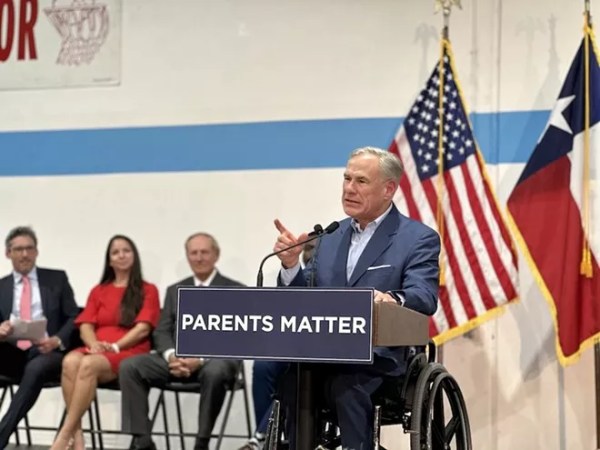
As Texas Gov. Greg Abbott continues to tour the state pushing for school vouchers that would sap public education funds, a new report finds that Texas already ranks among the worst states for both average per-pupil spending and teacher pay.
During the 2022-2023 school year, Texas spent on average of $12,503 per student per average daily attendance, according to analysis published on Monday by the Texas State Teachers Association (TSTA), which opposes Abbott’s voucher plan.
That ranks Texas 44th in the nation, according to the study. The national average per pupil spending is $17,132, according TSTA’s data.
“The record $33 billion budget surplus gave lawmakers a rare opportunity to address the teacher shortage and give our public schools the kind of forward-looking investment each of our 5 million-plus students need for a chance at a successful future,” TSTA President Ovidia Molina said in a statement. “Our leaders are failing both priorities.”
What’s more, the average teacher salary in Texas is now $60,716, according to the report. Although that number is up 3% from the last school year, TSTA found that, adjusted for inflation, this year’s number is actually a 4.72% reduction from what Texas teachers earned in 2014.
The new data on Texas’ lackluster spending on public education comes as Abbott, a Republican, continues to face pushback, including from rural lawmakers from his own party, on school voucher legislation.
Instead of advocating for more public education spending, Abbott continues to tout the state’s record surplus as a reason why Texas should pass school voucher legislation. If passed, so-called “school choice” bills like Senate Bill 8 would allow the state to dole out $8,000 checks to parents who pull their children from public school to pay for private school tuition.
Reductions in teacher pay and per-pupil spending are likely to worsen if the Texas Legislature adopts a large-scale voucher system, critics argue. They said lawmakers would likely refuse to boost public education spending even if inflation remains high.
Joshua Cowen, an education policy professor at Michigan State University, told the Current earlier this month that despite Texas’ budget surplus, sustaining two separate school systems is impossible in the long run.
“The cuts come by not keeping education spending up with inflation and keeping per-pupil dollars at their current average,” Cowen said. “No politician is going to vote to cut per-pupil spending because they would get thrown out of office. They would just vote to not increase spending, even if costs are rising.”
Follow us: Google News | NewsBreak | Instagram | Facebook | Twitter
Related Stories
Despite the governor’s voucher pitch, the answer to better Texas schools is more public funding

Gov. Greg Abbott rails against ‘leftist radical agenda’ during San Antonio school voucher speech

Bad Takes: Gov. Greg Abbott’s voucher plan would defund Texas’ public schools to aid wealthy elites

Teachers are losing hope that lawmakers will give them a big raise this session
This article appears in Apr 19 – May 2, 2023.
